
U-Care Courses
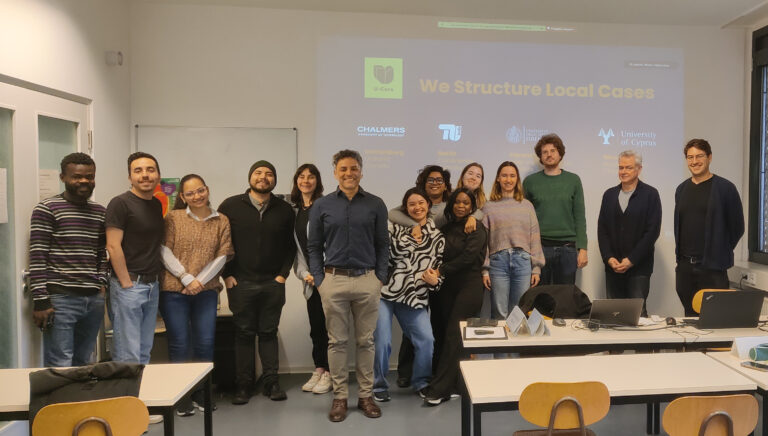
The U-CARE project develops learning modules that translate urban health research into practical education and capacity-building for higher education institutions. The modules are designed to equip students and professionals with the skills needed to address climate- and health-related challenges in urban environments through evidence-based, pedestrian-focused planning and design.
Learning Modules
The learning program is organized into a set of modular courses that combine practical training and capacity building. Practical training modules focus on data management practices and environmental health impact assessment, integrating both quantitative and qualitative research methods. Capacity-building modules address urban health policy and governance, health-centered urban planning and design, and urban health and development management. Together, these modules provide a comprehensive and applied understanding of how urban health evidence can inform planning, design, and decision-making.
Pilot Courses
These learning modules are currently being implemented through pilot courses hosted by partner universities, where the UrbanCare methodology is applied to real-world urban and climatic contexts. The pilot courses serve as testbeds for refining teaching formats, platform-supported learning, and cross-institutional collaboration.
- Combating the Impacts of Climate Change on Urban Ecosystems and Health Across Different Climatic Zones in Europe
This pilot course applies the UrbanCare methodology to environmental design challenges related to climate mitigation and adaptation in urban areas. Hosted by the Department of Architecture at the University of Florence, the course runs on site from March to May 2025 and focuses on developing design strategies that address climate-related health impacts across diverse European climatic zones. Teaching materials, including recorded lectures, presentations, and assignments, are made available online to support continued and remote learning.
- Healthy Urban Design and Planning for Mediterranean Cities
Hosted by the Department of Architecture at the University of Cyprus, this pilot course focuses on climate- and health-responsive urban planning and design in Mediterranean contexts. Running from September to December 2025, the course applies the UrbanCare methodology to site-specific challenges, emphasizing environmental design strategies that mitigate climate impacts on public health. Course materials are shared digitally to support hybrid participation and knowledge exchange.
Hybrid and Collaborative Teaching
The learning modules are implemented in a hybrid format, allowing participants to attend courses locally at their home institutions while engaging remotely with partner universities. This structure supports cross-institutional learning, shared teaching responsibilities, and the opportunity for participants to progress toward advanced levels of qualification based on their interests and experience. Courses are delivered over multi-week periods and aligned with academic accreditation systems.
Platform-Supported Learning
All modules are supported by the U-CARE Web Platform, which serves as a unified learning and methodological environment. The platform enables participants to explore real-world urban cases, interpret spatial and environmental data, and engage with standardized visual outputs at neighborhood and street scales. Rather than acting as a design or simulation tool, the platform supports analytical reasoning, comparison, and discussion within educational and workshop settings.
Knowledge Transfer and the U-CARE Learning Guide
To support long-term use and replication, learning materials and methodological guidance are consolidated in a multilingual U-CARE Learning Guide. The guide provides structured documentation of the UrbanCare methodology, platform use, teaching approaches, and lessons learned from pilot implementations. It serves as a reference for educators, practitioners, and institutions seeking to integrate urban health and climate-responsive planning into curricula and professional training.
Evaluation and Skills Development
The effectiveness of the learning modules is assessed through a combination of quantitative and qualitative evaluation methods. These include student participation and completion rates, assessment results, platform usage analytics, surveys, and tutor feedback. Evaluation focuses on skill acquisition, confidence in applying methods, and the relevance of the learning experience to emerging roles in urban health, climate adaptation, and integrated planning.
Long-Term Impact
By combining applied learning, digital tools, and standardized methodologies, the U-CARE project establishes an open and transferable educational framework for urban health. The learning modules and supporting materials enable universities and training providers to mainstream health-centered and climate-responsive urban planning in education, contributing to the preparation of future professionals for roles in the green and public health labor market across diverse institutional and geographic contexts.